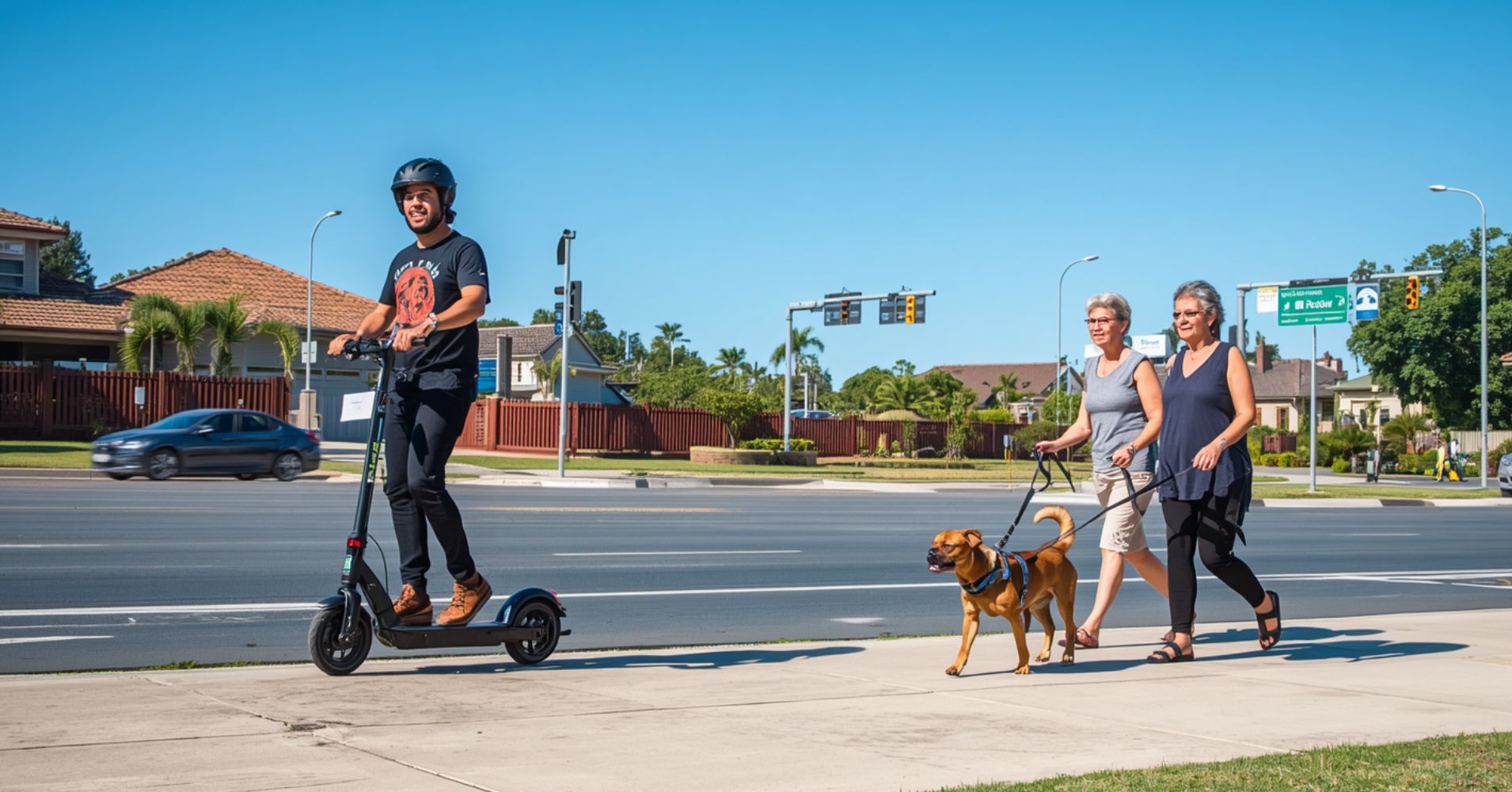
E-scooter footpath riding in Brisbane is allowed in many places, but only under clear conditions. Yes, you can currently ride an e-scooter on Brisbane footpaths unless signs prohibit personal mobility devices, but you must give way to pedestrians and stay at or below 12 km/h. Brisbane City Council gives the same direct answer for Brisbane footpaths, and Queensland Government rules set the wider personal mobility device requirements. Before riding, check signs, slow down near people and make sure your scooter fits the rules for public paths.
The short answer for Brisbane riders
E-scooter footpath riding in Brisbane is a yes, but not an unconditional yes. Brisbane City Council says e-scooters can be ridden on footpaths, shared paths and bike paths in Brisbane unless a “No PMD” sign is present.
- Footpaths: allowed unless a sign or local restriction prohibits personal mobility devices.
- Speed: the e-scooter speed limit on a footpath is 12 km/h under the Queensland Government’s current personal mobility device rules.
- Priority: pedestrians come first, so riders must give way and leave a safe passing distance.
For broader Queensland requirements, including helmet, age limits and device rules, see the MiniEVs guide to Queensland electric scooter laws. For the official wording, check the Queensland Government rules for personal mobility devices and Brisbane City Council e-mobility guidance.
The current footpath rule and speed limit
The Queensland Government rule is that a personal mobility device can be ridden on paths unless there is a sign prohibiting it. It also lists 12 km/h as the maximum speed on footpaths and shared paths, unless a shared path is signed otherwise.
In rider terms, the rule is simple: look for signs, keep left where possible, give way to pedestrians and ride safely enough to stop. The 12 km/h limit is a ceiling, not a target for busy shopfronts, bus stops, school frontages, ferry terminals or narrow CBD footpaths.
Where footpath riding is not allowed or may not be the best choice
A footpath can be legal to ride on and still be a poor choice at that moment. Signs, pedestrian numbers, path width and sightlines should decide whether you ride, slow to walking pace or get off.
- Quiet suburban footpath: ride slowly, keep left and watch driveways, dogs, children and parked cars blocking sightlines.
- Busy CBD footpath: slow to walking pace or walk the scooter if people cannot pass comfortably.
- South Bank or riverside-style paths: expect riders and pedestrians, runners and children to change direction without warning.
- Ferry terminals and bus stops: slow early because people may step out while looking for services, phones or bags.
- Separated path: use the bike side, not the pedestrian side, and obey any sign or path marking.
- Privately managed or high-pedestrian areas: check signs before assuming normal footpath access applies.

A quick legal but unwise decision guide
Allowed does not always mean sensible. Use this check before choosing the footpath over shared paths, a bike path, a bicycle lane or a permitted local street.
| Situation | Better choice | Why it matters |
|---|---|---|
| Wide, quiet footpath with clear sightlines | Ride slowly and keep left | You have room to pass and time to react. |
| Narrow path beside shops or cafes | Slow to walking pace | People can step out from doors, tables or parked cars. |
| Crowded CBD or event area | Get off and walk | You cannot give pedestrians enough space at riding speed. |
| Wet surface, leaves, gravel or poor tyre grip | Slow down or choose another route | Braking and turning distance increase. |
| Blind driveway, school frontage or bus stop | Cover the brakes and slow before the hazard | Pedestrians and cars may appear with little warning. |
Footpath, shared path, bike path or road
Route choice affects both safety and compliance. Many Brisbane riders say “footpath” when they mean any off-road path, but the road rules and risks change by path type.
| Option | When it usually fits | Current rule or practical note |
|---|---|---|
| Footpath | Short local trips and low-pedestrian streets | Maximum 12 km/h and pedestrians have priority. |
| Shared path | Routes used by walkers, a bike rider and personal mobility device riders | Maximum 12 km/h unless signed otherwise, with extra care around pedestrians. |
| Separated path | Paths with separate rider and pedestrian sides | Use the bike side, not the pedestrian side. The limit is 25 km/h unless signed otherwise. |
| Bike path | More direct riding where bikes and PMDs are expected | The limit is 25 km/h unless a lower sign applies. |
| Bike lane | Road sections with a marked bike lane | Bike lanes on roads with a road speed of 50 km/h or less can be used by personal mobility device riders, with a 25 km/h maximum for the device. |
| Physically separated lane | Protected riding space beside traffic | A bike lane that is physically separated from other lanes of traffic, such as a lane that is physically separated from the road by bollards or a raised median strip, can be used regardless of the speed limit on the adjoining road. |
| Local streets | Low-speed streets that meet the road-use conditions | You may ride on the road where the limit is 50 km/h or less and there is no dividing line or median strip. |
On-road bike lanes are different from every bicycle lane you see, so check whether the lane is physically separated or whether the road itself meets the rule. These same state rules apply beyond Brisbane, including the Gold Coast, although local signs and managed precincts can still change where riding is allowed.
How to ride near pedestrians without causing problems
Giving way to pedestrians means riding so walkers do not have to jump aside, stop suddenly or guess your next move. Brisbane City Council also advises riders to keep left, give way and brake early.
- Slow down before passing, not while you are already beside someone.
- Use a bell or clear verbal warning early, then pass with space.
- Do not weave through groups of people.
- Keep extra distance near children, dogs, mobility aids and prams.
- Be ready to stop at driveways, building exits, bus stops and blind corners.
- Get off and walk when the path is crowded or too narrow to pass safely.
Parents and new riders should not treat footpaths as a practice space at speed. Start in a quiet area, learn braking control first and use a low-speed mode where the scooter has one.

Other rules for riders to remember
E-scooter rules are not only about where you can ride an electric scooter. The general road rules also cover age, helmets, phones, passengers and what to do after a crash.
- Age: a rider must be 16 or older, or at least 12 and supervised by an adult while riding.
- Helmet: you must wear an approved bicycle helmet or an approved motorbike helmet unless a lawful exemption applies.
- Mobile phone: you must not use a mobile phone while riding, including holding a mobile phone in your hand.
- Passengers: it is against the law to carry another person on a PMD, so do not carry another person on the deck or handlebars.
- Night or poor visibility: at night or in hazardous conditions, lights and a rear reflector help other people see you.
- Crashes: if you are involved in a crash, you may need to remain at the scene and help anyone involved in the crash.
- Care: riding without due care and attention can still be a problem even when the route itself is allowed.
Fines apply for some rule breaches, so treat this as safety guidance rather than a complete legal checklist.
What Queensland rule changes could mean for footpath riding
The Transport and Other Legislation (Managing E-mobility Use and Protecting Our Communities) Amendment Bill 2026 was introduced in Queensland Parliament in March 2026 and proposed e-mobility changes, including a 10 km/h approach for footpaths and shared paths. That proposal should not be treated as commenced law unless official Queensland sources say it has started.
On 8 May 2026, the parliamentary committee’s executive summary recommended changing the proposed 10 km/h approach so it applied only to footpaths in high pedestrian areas, with further consideration of lower speeds near pedestrians. It also recommended that the 10 km/h limit should not apply to shared paths unless signed.
Check before you ride: if you are reading this after new rules commence, confirm the active law on the Queensland Government personal mobility device page and Brisbane City Council e-mobility page before relying on any speed limit.
Make sure your scooter is safe and compliant before riding
An e-scooter needs to fit the personal mobility device category before you assume the footpath rules apply. Queensland Government guidance describes PMDs as devices designed for one person, powered by an electric motor, with size and weight limits, and excludes some other device types.
- Device category: e-scooters and e-bikes are treated differently, and small foot powered scooters are not the same legal category as a PMD like an e-scooter.
- Electric motor: a compliant PMD uses a small electric motor and must fit the category rules before it is treated as an e-scooter for public riding.
- Speed capability and modifications: fast or modified scooters can create legal and safety risk, especially if they no longer match the assumed PMD rules.
- Brakes: weak brakes increase stopping distance around pedestrians, driveways and corners.
- Tyres: worn, flat or damaged tyres reduce grip and can make braking less predictable.
- Lights and reflector: low light, rain and night riding require visibility from the front and rear.
- Bell or horn: a warning device helps you alert pedestrians before passing.
MiniEVs sells e-scooters and electric mobility products, with a Capalaba store and a Mt Gravatt service and repair centre. It also offers Brisbane e-scooter tyre and tube repairs, which is relevant because tyres, tubes and braking condition affect safe footpath riding.

Before you ride in Brisbane
Brisbane e-scooter riding is easiest to manage when you check the rule, the route and the device before you leave. Use this as a quick pre-ride check.
- Check for “No PMD” signs or local restrictions.
- Stay at or below the footpath speed limit.
- Give pedestrians priority and pass with space.
- Use the correct side on separated paths.
- Use only permitted on-road bike lanes or local streets if leaving the path.
- Check brakes, tyres, lights and bell or horn before riding.
FAQs about e-scooters on Brisbane footpaths
Can I ride an e-scooter on a busy Brisbane CBD footpath?
You may be allowed to ride unless signs prohibit personal mobility devices, but a busy CBD footpath may not be a sensible place to ride. If there is not enough room to pass pedestrians safely, slow to walking pace or get off and walk the scooter.
Do I have to give way to pedestrians?
Yes. Queensland Government and Brisbane City Council guidance both make pedestrian priority clear. In practice, this means slowing before you pass, leaving space and riding so pedestrians do not have to change course suddenly because of your scooter.
Can I ride on the road instead?
Sometimes. Queensland guidance allows e-scooters in bike lanes on roads with a speed limit of 50 km/h or less, in physically separated bike lanes, and on local streets with a 50 km/h or lower speed limit and no dividing line. Check the full PMD rules before choosing the road.
What speed can I ride on Brisbane footpaths?
The listed footpath maximum is 12 km/h. Ride slower near pedestrians, shopfronts, ferry terminals, bus stops, school areas, driveways and blind corners. A lower speed is often the only way to give way properly.
What if my scooter is modified or very fast?
Do not assume the normal footpath rules apply to every modified or high-powered scooter. If a device falls outside the personal mobility device requirements, it may not be treated the same way as a compliant e-scooter. Check the official rules before riding it in public.
Disclaimer: This article is general information only and is not legal advice. E-scooter rules, speed limits, signage and enforcement can change. Before riding, check the current Queensland Government personal mobility device rules, Brisbane City Council guidance and any signs or local restrictions that apply to your route.

Featured Products